What Africa Is Teaching Us About the Future of Localization

Notes from ALCA 2026, by Kirti Vashee

In summary

Language AI is emerging as a critical enabler of Africa’s digital and economic growth, according to observations from ALCA 2026 in Accra, Ghana.

As more people come online, connectivity alone is not enough. Businesses and public services need language infrastructure that allows people to access information and engage in the languages they know best.

The conference highlighted growing demand for local language AI, data sovereignty, and broader language coverage, alongside a pragmatic approach to AI that emphasizes adoption over replacement.

For localization leaders, Africa offers an early view of how language AI can expand markets, support economic development, and reshape the role of localization.

Read more to discover the key themes from ALCA 2026 and what they could mean for the future of localization.

East Legon (Accra), Aug 28, 2026

The ALCA conference was held in Accra, Ghana, in late August. It was an engaging and highly participatory event that continues to expand in scope and the quality of its content compared to the previous conference.

The impact of language technology in Africa extends far beyond typical international commercial success stories seen in the Global North. Here, language work carries significantly higher stakes, serving as a vital catalyst for economic growth and long-term improvements in human well-being.

Over the coming decades, Africa is projected to have the world’s largest share of young people. While this demographic shift presents a substantial opportunity for an economic expansion powered by a demographic dividend, the rapid surge in the working-age population also introduces significant challenges. Capitalizing on this burgeoning youth workforce effectively will require establishing robust critical infrastructure.

    1. • The “demographic dividend” only materializes if the young population gains access to quality education, health information, and employment – all of which are gated behind language barriers today
    1. • Connectivity alone is not enough. Language AI is the layer that determines whether connectivity actually converts into usable access to drive economic progress and momentum.

The conference featured a range of standout presentations focusing on data sovereignty, localization best practices, cultural identity, and the link between language access and economic growth. While the impact of AI on translation work was also discussed as a secondary theme, the tone surrounding it was noticeably less pessimistic than in the Global North. Instead of fearing replacement by advancing language AI, African students demonstrated a keen enthusiasm to embrace the technology and position themselves as its future leaders and experts.

Across the continent, an NLP-savvy community is emerging alongside an expanding library of open-source tools and data resources. Throughout the Global South, code-switching—alternating between multiple languages within a single interaction—is widespread, demanding adaptive and specialized capabilities from AI systems.

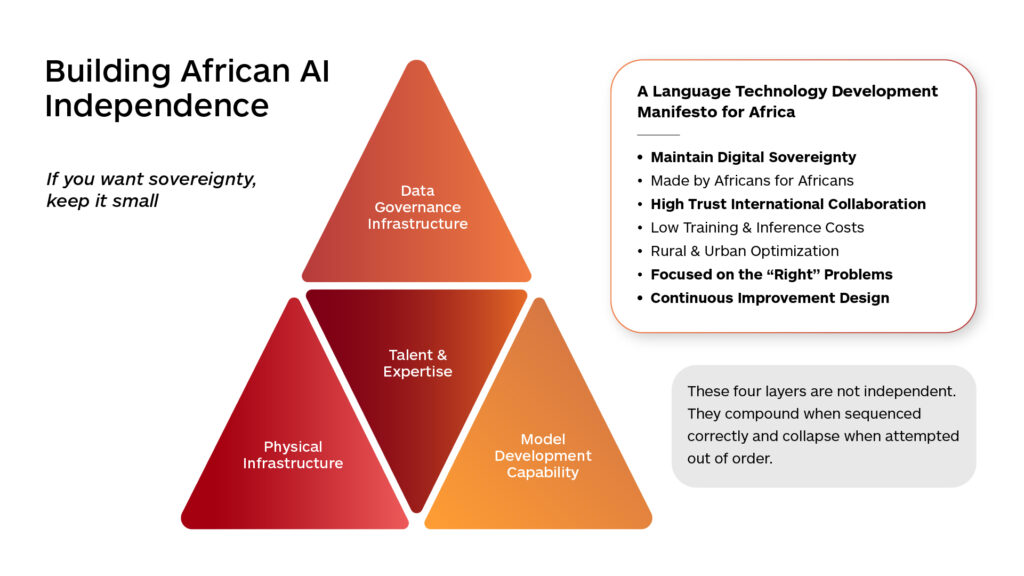
In his opening keynote, Prof. Isaac Wiafe (UG) underscored recent advancements in speech and voice recognition while raising critical questions: If AI cannot communicate in our languages, whose economy is it actually developing, and who reaps the rewards? He noted that Ghana has approximately 79 languages (11 of which have written forms) that remain vibrant in social contexts despite being digitally sparse and fragmented. Emphasizing that linguistic sovereignty is fundamental to economic independence, he stressed the imperative for African models to be trained on African data with significant African involvement.

The University of Ghana stands at the forefront of creating sovereign, NLP-ready datasets and developing local language LLM models. With Ghana and several other African nations experiencing robust annual GDP growth between 6.5% and 7%, North American and European businesses have strong incentives to take notice.

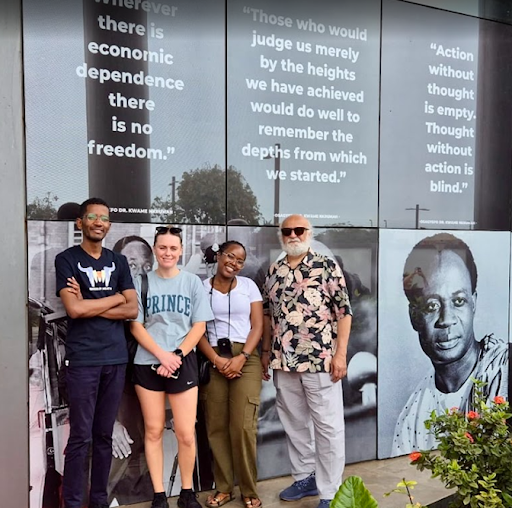
The event featured several engaging, high-impact case studies demonstrating how language access influences health education and online learning. Notably, Jade Gola from CLUE shared an impressive case study on a Women’s Health application that gained strong traction across Arabic-speaking nations. By offering high-quality educational resources covering reproductive and menstrual health, the app has meaningfully enriched the lives of young women. The presentation highlighted both the growing responsibilities of localization departments and the proactive integration of AI to advance their mission.

The language service companies in attendance outlined the challenges associated with client expectations regarding AI translation, particularly the misconception that it is both cost-free and error-free. They noted the rapid adoption of the machine translation post-editing (MTPE) model, which has prompted providers to increasingly articulate their value proposition in terms of governance and risk mitigation. Consequently, language service providers (LSPs) and translators in Africa will likely need to accelerate their adoption of AI technologies.

Johan Botha delivered a highly perceptive presentation illustrating a mature and nuanced grasp of AI’s realistic capabilities. He emphasized that performance varies considerably across different African languages and that moving from availability to actual adoption and deployment is an intricate, demanding journey shaped by specific use cases, languages, and strategic goals. Compared to past years, the industry shows a far more mature understanding of AI’s practical utility and value, recognizing that incorporating human oversight and escalation is an intentional feature of system design rather than a flaw. Furthermore, industry leaders acknowledge that the scope of value-added services extends well beyond standard translation; as a result, African LSPs appear well-positioned to outpace their Northern counterparts in adopting AI and pinpointing key areas of value creation.

Co-presenting alongside Sherif Isaaka of ALL, I emphasized the expanding opportunities for commercial success and national economic momentum, noting how language service companies can act as key accelerators of overall growth. Additionally, I suggested that India’s language AI development framework serves as a far more viable model for Africa than the infrastructure-heavy approaches of the US and EU, which are simply unfeasible in this context.

The Role for LSPs

  • Human-in-the-loop at professional scale: Extending AI infrastructure to African languages — under Masakhane/CLEAR Global-style fair-compensation principles rather than extractive crowdsourcing — solves the data-quality and ethics problem at once
  • Adaptive MT as the near-term bridge: LSPs can wrap existing LLMs with continuously learning MT layers that improve from daily corrective feedback
  • Turning community models into commercial products: Convert research to production-funded usage
  • Fluency and cultural QA, not just accuracy: LSPs’ core competency — transcreation, not just translation — directly addresses the accuracy/fluency gap
  • Funding data infrastructure and compute access as a partner, not an extractor: Co-investing in data acquisition (paying for it, licensing it, crediting contributors) rather than scraping or automated data harvesting
  • Facilitate & convene collaboration: Pulling grassroots researchers, efficient model builders, humanitarian data orgs, and enterprise initiatives into the same room to leverage and accelerate data acquisition and refinement
  • Model, Data & Cultural Evaluation

The drive and enthusiasm demonstrated by the attending University of Ghana students give me great optimism regarding the rapid pace of advancement and the growing opportunities that could be enabled by technological progress. Considering Ghana’s historical significance as the first nation in Africa to achieve independence after six centuries of European colonial rule, the slave trade, and resource exploitation, this momentum is truly remarkable. Ghana seems exceptionally well-placed to lead the way in the evolving landscape of language technology.

It was also gratifying to learn that Lara Translate outperformed several major AI foundation models and leading commercial MT systems across tests conducted by attendees on various African languages. They were also very impressed by the extent of the coverage, as we have more African languages than both Google & DeepL

African Language Coverage

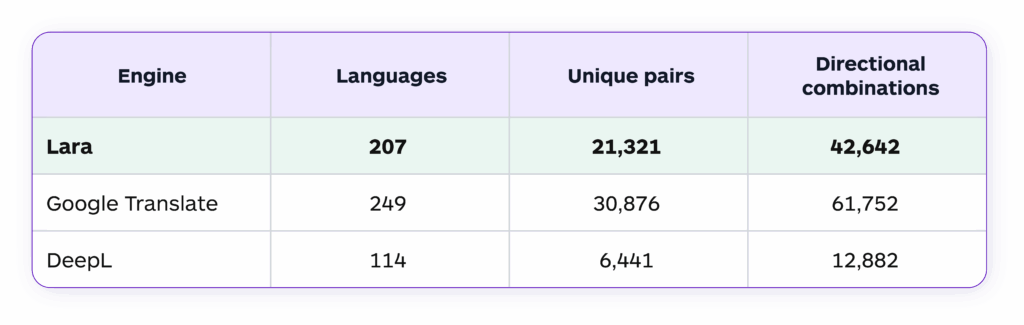
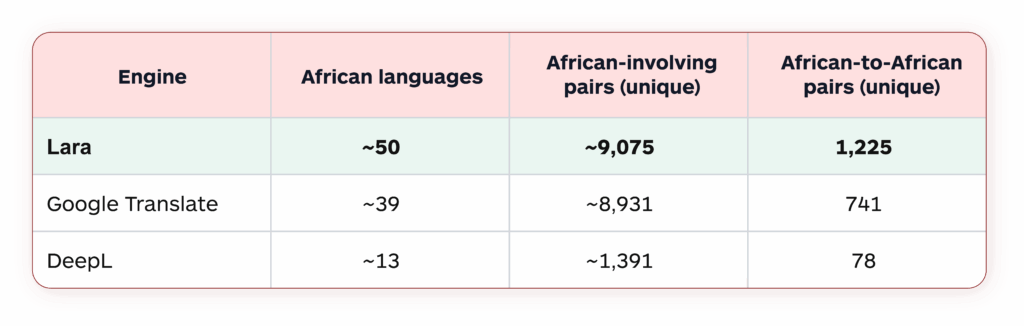
One practical implication of this shift is that language coverage matters differently in Africa. Supporting the major global languages is not enough when economic and digital participation depends on a much wider set of local languages and language pairs. This is where the differences between translation systems become especially relevant.

Lara currently supports around 50 African languages, compared with approximately 39 for Google Translate and 13 for DeepL, giving it much broader coverage across African language combinations.

Beyond the numbers, Lara supports many African languages that remain unavailable in other engines, including Amharic, Somali, Yoruba, Igbo, Kinyarwanda, Akan (Twi), Ewe, Hausa, Wolof, Tigrinya, Luganda, and many others. In practice, this broader coverage allows organizations to reach communities that would otherwise remain underserved by mainstream translation engines.

Discover Lara 3