Language Technology Value: The Shift to Language Intelligence

By Kirti Vashee, Translated's Tech Evangelist

The language services industry stands at a critical inflection point. While translation technology has traditionally been positioned as a tool for reducing costs and improving efficiency, this narrow focus has caused many organizations to miss the transformative business value that language intelligence can deliver.

Research from Nimdzi, Common Sense Advisory, McKinsey, and Forrester reveals that the most successful deployments of language technology generate value through revenue growth, market expansion, enhanced customer experience, and competitive advantage—outcomes that far exceed the limited gains from optimizing cost-per-word metrics.

This article explores the deeper business impact made possible by translation technology and identifies the elements needed to deliver truly high value through its extensive and strategic use.

Understanding Business Value

What is the Impact of Technology on Business Value?

  • Increased Efficiency & Productivity & Cost Reduction
  • Enhanced Customer Experience (CX)
  • Improved Decision-Making based on Analysis of Large Volumes of Data
  • Improve & Enhance Existing Capabilities through Innovation to Build Competitive Advantage
  • Identify, Assess, & Mitigate Risks & Enhance Security
  • Revenue Growth & Market Expansion
  • Greater Agility & Flexibility in Response to Change

Across every industry, digital interactions are exploding in volume, variety, and velocity. Customer journeys are increasingly self-service, omnichannel, and global by default. As this happens, language is no longer a peripheral “last-mile” problem; it is becoming a core system of record for how enterprises communicate, learn, and grow.

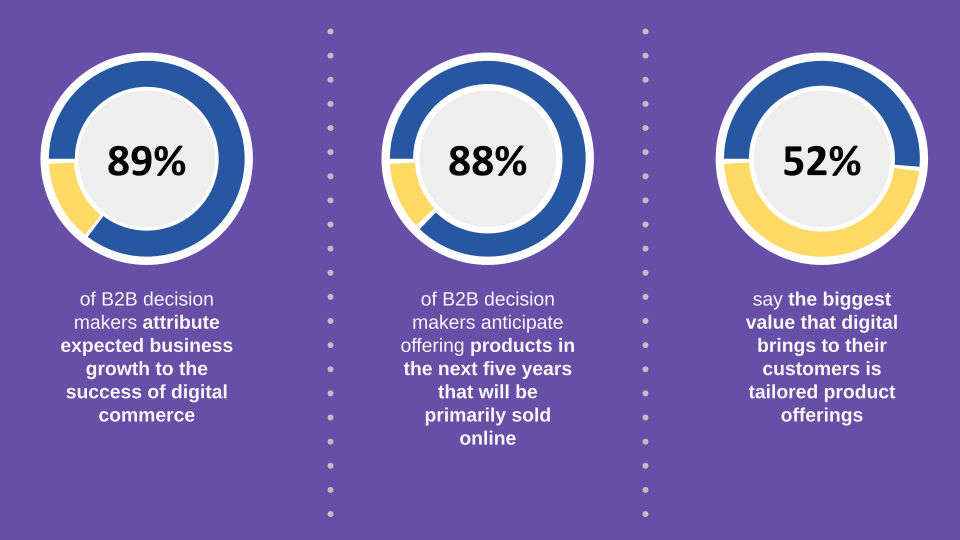
Information availability and CX standards defined in B2C are now expected in B2B. B2B buyers expect tailored digital experiences, instant answers, and product discovery in their own language—at scale. More than half of B2B companies surveyed recently by Salesforce say the greatest value of digital is tailored product offerings:

  • 89% of B2B decision makers attribute expected business growth to the success of digital commerce
  • 88% of B2B decision makers anticipate offering products in the next five years that will be primarily sold online
  • 52% say the biggest value that digital brings to their customers is tailored product offerings

(Source: Cloudcraze / Salesforce Survey of 460 B2B Business)

However, most of the industry has historically framed value in terms of efficiency and cost per word. Nimdzi’s recent analysis of the language services market shows that per-word commoditization has pushed many LSPs into a race to the bottom on pricing, with discounts, productivity gains, and unit-cost reductions as their primary value story. At the same time, clients are adopting their own LLM-based workflows, becoming more independent and self-sufficient, creating real disruption for providers who cannot articulate value beyond cheaper words

To unlock high, durable business impact, enterprises and their language partners must fundamentally reframe the role of language technology: from a productivity tool for localization teams to infrastructure for global customer experience, revenue growth, and international business intelligence.

The Limitations of the Traditional Localization Model

The traditional segment-based localization model is structurally designed for low-volume, high-quality assets (e.g., UI strings, legal content, basic documentation, marketing copy). Even when augmented with Machine Translation (MT), this model creates several strategic bottlenecks:

  • The Efficiency Trap: The industry remains narrowly focused on Post-Editing (PEMT) to achieve small gains in translator speed and lower costs per word. While valid, this approach ignores broader value creation and creates price pressure.
  • Misaligned Use Cases: High-stakes content is often a poor candidate for MT. The volumes are too low and the quality requirements too high to yield significant efficiency returns. Furthermore, delays in this category are usually caused by approval cycles, not translation speed.
  • Operational Bloat: The hybrid workflow—combining Translation Memory, MT, Quality Estimation, and Post-Editing—is overly complex. This operational heaviness creates a difficult-to-manage production environment that adds cost without delivering tangible value to business leaders in marketing or product.
  • Metric Myopia: There is an overemphasis on linguistic metrics (such as BLEU/COMET scores) rather than business outcomes. While LSPs struggle with technical quality estimation, primary stakeholders are more concerned with time to market, Net Promoter Score (NPS), and revenue.

The Market Consequence

Because LSPs have largely focused on technical metrics rather than core business drivers, they have missed the opportunity to position MT as a strategic asset for the C-suite.

Nimdzi notes that language services often sit in the back seat relative to core business metrics like revenue growth, conversion, and brand engagement, despite clear evidence that tech-forward LSPs and AI-first models are capturing a disproportionate share of industry growth and profitability.

Consequently, client organizations are now bypassing vendors and adopting general-purpose LLMs directly. This shift signals that customers view language technology as a strategic capability, not just an outsourced service.

Traditional localization focuses on translated marketing materials, websites, and product documentation. However, “localization” is just one of many use cases for language technology.

The true value of modern language technologies lies in their capacity to transform a company’s operating model, deepen data-driven decision-making, and enable customer-centered innovation.

Beyond Efficiency: The Real Business Impact

Research by CSA Research, Nimdzi, McKinsey, and Forrester converges on a key insight: Companies that treat language and localization as strategic enablers outperform those that treat them as cost centers.

Key Impact Areas

  • Market Expansion: Technology enables companies to enter, localize, and thrive in new markets at scale, empowering small firms and startups to compete globally. CSA Research data shows that companies investing in localization are 1.8x more likely to grow revenue and 1.5x more likely to increase profits. Conversely, 40% of consumers will never buy from a website not in their language.
  • Customer Loyalty (CX): Forrester and McKinsey link superior Customer Experience (CX) to higher shareholder returns. Offering support in a customer’s native language is a strategic lever: 75% of customers are more likely to repurchase from brands that do so.
  • Revenue Growth: Multilingual digital channels powered by translation tech drive sales conversion, provide tailored product offerings, and personalize digital experiences for diverse audiences. Localized digital experiences generate up to 70% higher conversion rates. For SaaS and e-commerce, increasing translation budgets correlates directly with revenue uplift.
  • Brand Equity and Trust: Effective language technologies help companies build credibility, avoid costly miscommunication, and demonstrate cultural insight—critical for international brand reputation.
  • Data Intelligence: McKinsey emphasizes that cross-border data flows now drive global GDP more than physical trade. Language technology unlocks "dark data" (multilingual reviews, tickets, and feedback), turning it into actionable intelligence for product and strategy decisions.
  • Utility Over Perfection: A Microsoft case study on knowledge base content illustrates that business value often outweighs linguistic perfection. When measuring whether a support article "solved the problem," success rates for MT were nearly statistically equivalent to Human Translation across many languages. This proves that MT is a viable solution for high-volume, self-service content, where utility and immediate access matter most.
  • Employee Enablement and Global Collaboration: Organizations providing multilingual support for staff achieve measurably higher market share and foster inclusion and agility.
  • Agility and Innovation: As highlighted by McKinsey and Forrester, AI-driven language platforms enable rapid response to market changes, customer needs, and regulatory requirements, giving global firms a decisive edge.
When language technology is deployed as infrastructure for revenue and CX, the return on investment expands dramatically beyond simple cost savings.

Where Does Language Technology Create the Highest Business Impact?

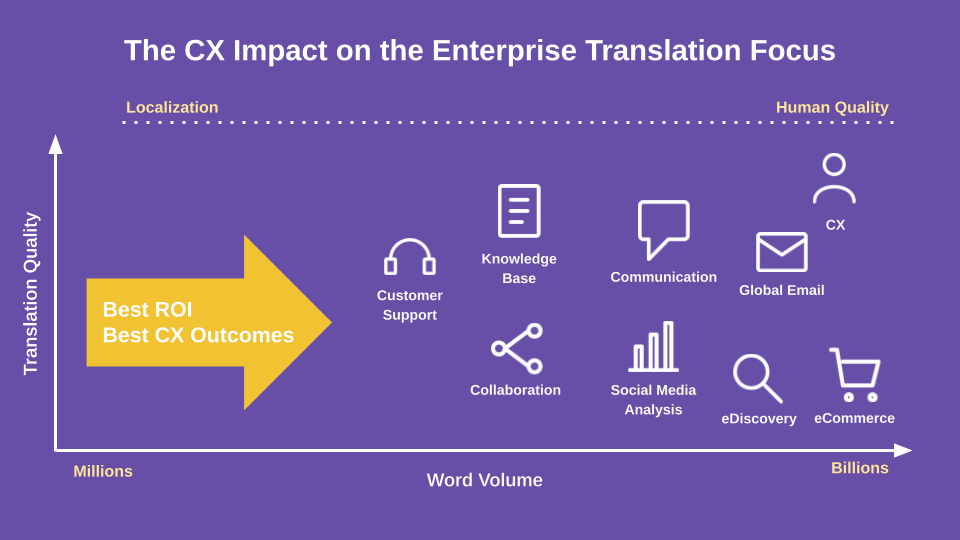
MT and related language technologies deliver their greatest value in the high-volume, dynamic flows of global customer interaction and collaboration, not in narrow localization workflows.

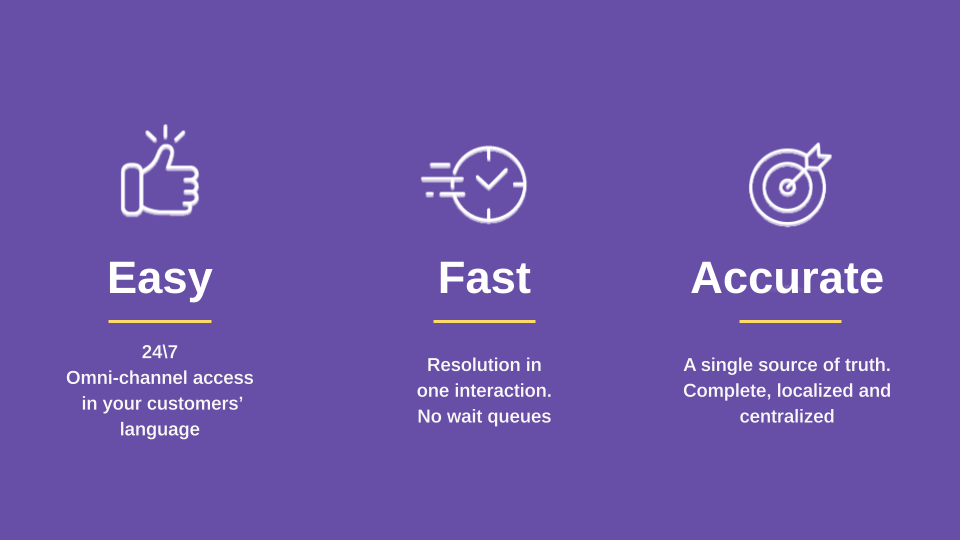
Tech-Savvy Customers Demand the Best

  • Easy
    24/7 - Omni-channel access in your customers’ language
  • Fast
    Resolution in one interaction.
    No wait queues
  • Accurate
    A single source of truth.
    Complete, localized and centralized

1. The Evolution of Customer Support: From Static to Dynamic

Customer support has shifted from static documentation to dynamic, unstructured interactions across chat, social media, video, and voice. MT and LLMs are uniquely effective in this environment, driving value in three key areas:

  • Massive Expansion of Coverage: Enterprises can now translate entire knowledge bases, FAQs, and community forums into dozens of languages instantly. By using a mix of pre-translation and on-demand MT, companies dramatically increase self-service success rates and reduce the volume of inbound support tickets.
  • Speed and Efficiency: Real-time MT for chat, email, and social messaging allows smaller support teams to manage global inquiries without hiring native speakers for every language pair. This improves response times and creates a perception of high responsiveness and availability.
  • Data-Driven Product Insights: MT unlocks the value of multilingual feedback. By translating tickets, chats, and reviews into a single language, teams can analyze global data to spot trends. This reveals what customers care about across different geographies, directly informing product roadmaps and quality improvements.

The positive outcomes of using language AI in customer support directly translate into the key performance indicators (KPIs) that matter to executives. These critical metrics include:

  • First-contact resolution
  • Time to resolution
  • Self-service deflection
  • NPS (Net Promoter Score)
  • Churn (Customer Attrition)

Analysts note that the Language Service Providers and technology-forward companies thriving in the current environment are those that link language capabilities directly to such business outcomes rather than focusing solely on traditional per-word metrics.

2. eCommerce and Digital Sales

Digital commerce is now a primary engine for future growth, with research confirming that localized websites and digital journeys can deliver a 20–25% or more uplift in sales in target markets.

Language technology is essential for realizing this growth, specifically enabling three key functions:

  • Rapid Scale for Product Content: MT can keep pace with the constant changes in SKUs (product codes), promotional campaigns, and User-Generated Content (UGC) like customer reviews. This rapid, localized rollout is vital for conversion and SEO, as human-only processes cannot match the volume and speed required.
  • Hyper-Localized Testing & Optimization: Combining MT with specific linguistic adaptation workflows allows teams to quickly create, test, and iterate localized messaging. This focuses optimization efforts on maximizing conversion and A/B test results rather than merely achieving linguistic perfection.
  • Enhanced Multilingual Findability and SEO: Programmatic translation and optimization of critical elements—such as metadata, category structures, and on-site search—significantly increases visibility in local search engines and marketplaces, thereby amplifying overall marketing spend.

McKinsey’s work on personalization and CX shows that companies that excel at personalization, including tailored content and offers, achieve significant revenue and loyalty advantages. Language is one of the most powerful personalization signals: speaking the customer’s language at every step of the journey.

3. Internal Communications and Global Collaboration

Language technology is a major value driver for internal operations, significantly enhancing corporate communication and collaboration across global teams.

Specifically, language technology facilitates the following:

Seamless Global Collaboration: Integrating MT directly into internal platforms (like email, chat, document repositories, and knowledge systems) removes friction in cross-border communication. This keeps global teams—especially those in product development, operations, and field service—aligned and working efficiently.

Unlocking Institutional Knowledge: By automatically translating and indexing internal documentation and training content, organizations prevent language-based knowledge silos. This ensures that valuable best practices and accumulated institutional knowledge are easily discoverable and accessible to employees across all regions.

Accelerated Global Execution: Multilingual communication flows smoothly, leading to faster execution of critical global initiatives. This reduces delays and misalignment across functions—from rolling out compliance updates and HR policies to executing large-scale global marketing campaigns.

These benefits aren't reflected in the localization budget itself, but they directly impact organizational health and performance metrics such as project cycle times, error rates, and employee engagement. McKinsey identifies these latter measures as key indicators of overall organizational strength.

4. Strategic Insight from Multilingual Data

Language technology's final major role is converting multilingual text and speech into analyzable data, which fuels analytics, AI, and strategic decision-making for international business initiatives.

  • Aggregating Global Feedback and Sentiment: MT combined with Natural Language Processing (NLP) pipelines standardizes feedback from sources like surveys, social media, reviews, and support tickets. This provides executives with comparable data across all markets, quickly revealing region-specific issues and growth opportunities.
  • Informing Pricing and Product Strategy: Language intelligence supplies the crucial local insight needed to optimize market strategies. Research shows that localized offers and regional pricing strategies are key to maximizing ARPU (Average Revenue Per User) and market share.
  • Fueling Enterprise AI Initiatives: High-quality multilingual data—including conversational history, terminology, and content corpora—serves as valuable fuel for an organization's internal AI models and decision engines, provided the data is properly governed and anonymized.

Thus, language technology can be a source of high-value data to acquire, organize, and analyze the upstream market data to drive business intelligence and strategy, rather than just a downstream translation service that it often is.

Value Realization: Language Technology as a Strategic Asset

To realize this broader value, enterprises and their partners must approach translation technology as a strategic program, not as a tool-deployment or a translation-management service.

1. Start from the Customer and Work Backwards

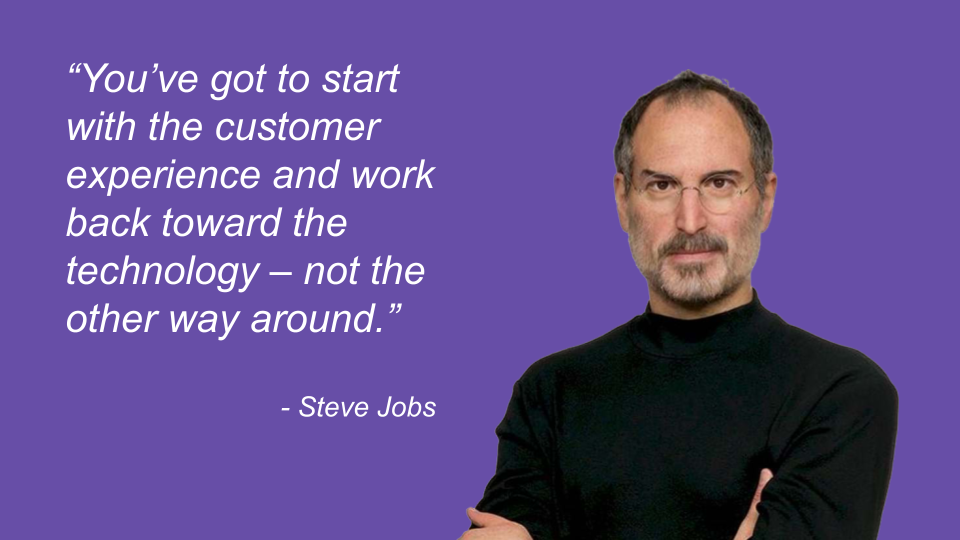
The core principle for technology adoption should be to "Start with the customer experience and work back toward the technology—not the other way around." This principle, emphasized by leaders like Steve Jobs and Jeff Bezos, means that choices regarding technology (such as MT engines, LLMs, TMS, or connectors) must be driven by clear business and Customer Experience (CX) objectives.

To anchor language strategy effectively, organizations must ask three key questions:

  1. Customer Problems: What specific problems are customers attempting to solve in each language?
  2. Critical Journeys: What are the most vital customer journeys, such as onboarding, troubleshooting, purchase, renewal, or advocacy?
  3. Friction Points: Where do current language barriers create the most friction, leading to abandonment or high support volume?

McKinsey’s research on digital CX reinforces this approach, stressing the need to map complete, end-to-end customer journeys. Strategy should focus intently on the few "moments that matter"—those touchpoints where an improved language experience will yield the greatest business returns.

2. Align Quality Expectations with Business Purpose

This approach reflects a fundamental shift in how the industry views translation quality:

  • Not all content requires the same quality bar. Quality is a spectrum, not a single standard.
  • "Good enough" is defined by whether the content fulfills its business purpose, not by linguistic perfection.

Applying Tiered Quality

Different content types require different localization approaches based on their business impact:

  • Highest Quality (Human Focus): Legal contracts and primary brand-marketing campaigns typically require high-touch human translation and meticulous review due to their critical nature.
  • Mid-Tier Quality (Augmented MT): Knowledge-base articles and support documentation can be efficiently managed using custom MT and linguistic steering. Post-editing is applied selectively, based on content impact and usage data.
  • Utility Quality (MT-Only): High-volume, dynamic content like community forum posts, user reviews, and internal chat transcripts can be handled solely by MT, with automated monitoring to flag critical issues.
The Microsoft KB self-service case study illustrates this principle: MT output, even if linguistically imperfect, achieved comparable success rates to human translation in solving customer problems. The key takeaway is to measure outcomes such as problem resolution, Customer Satisfaction (CSAT), and self-service deflection, instead of focusing solely on word-level quality metrics.

3. Build an Automation-First Operating Model

Language technology (LangTech) relies on three pillars: automation, empowerment, and effective data organization. But technology alone does not create value—the right strategy, adoption model, and change leadership are essential. McKinsey’s and Forrester’s studies underscore that the real drivers of impact are:

  • Rigorous value-tracking and business-case alignment
  • Linking technology investments to operating model and data foundation upgrades.
  • Upskilling staff and embedding AI capabilities into day-to-day business workflows.

Concretely, achieving this success means implementing the following requirements:

1. Deep Integration into Digital Platforms

Machine Translation and localization workflows must integrate natively with core business systems, including:

  • CMSs (Content Management Systems)
  • E-commerce platforms
  • CRMs (Customer Relationship Management)
  • Support desks
  • Developer pipelines
  • Collaboration tools

This deep integration enables continuous localization, automated triggers for translation, and real-time translation for support interactions.

2. Event-Driven, API-Based Orchestration

Modern translation should be triggered by real-time events rather than traditional batch file transfers. Translation should start automatically when an event occurs, such as:

  • A new product is launched.
  • Content is published or updated.
  • A support ticket is created, or a chat session begins.

Modern language platforms and Language Service Providers with strong engineering capabilities are differentiating themselves by offering this API-based, event-driven orchestration.

3. Granular Workflow Design

Automation does not mean removing humans; it means intelligent design. Successful workflows combine MT, human oversight, and quality estimation in specific ways that fit the content type and its business impact. This approach also empowers local teams to actively influence localization priorities.

McKinsey’s broader research on automation notes that companies capturing the greatest value from automation focus on end-to-end process redesign rather than simply “lifting and shifting” manual steps into digital workflows. The same applies to translation: the goal is not to digitize old localization processes, but to redesign global content and communication flows around automation.

4. Self-Service for Both Customers and Internal Stakeholders

Self-service is a de facto standard in digital life. Pervasive and easily accessible translation capabilities are a core requirement of delivering higher value. The strategic goal is to establish a self-service model for both customers and internal stakeholders, significantly reducing dependencies on centralized teams and opaque request queues. This powerful concept drives efficiency and speed across the organization:

For Customers

The self-service model minimizes reliance on human agents and reduces latency by providing immediate, multilingual solutions. Language technology is critical here, fueling:

  • Multilingual Self-Service Portals: Customers can access knowledge bases and FAQs in their native language.
  • Virtual Assistants: AI-powered bots and assistants provide instant support.

Language technology ensures that these experiences remain current, accurate, and up-to-date across all global markets.

For Internal Stakeholders

Localization should operate as a utility that internal teams can access directly, eliminating the bottleneck of traditional, ticket-based request systems. Instead, teams across Marketing, Product, Support, HR, and Field Services are empowered to:

  • Request & Inspect: Directly request translations and monitor their status.
  • Leverage: Instantly integrate and use translated content.

This is achieved by providing self-service portals, dashboards, and connectors that allow teams to plug directly into translation pipelines, managed with appropriate governance and quality guardrails.

Industry analysts confirm that Language Service Providers and platforms that enable this type of empowerment, often via APIs, SaaS platforms, and embedded workflows, are gaining market share, especially in mid-market companies where agility and speed are paramount.

5. Treat Language Data as a Strategic Asset

Well-managed multilingual data resources can be a strategic resource to inform and enhance all current and future global business initiatives. The foundation for a successful language strategy is robust data organization, which makes multilingual resources accessible, easily leverageable, and usable across new global initiatives.

Key Requirements for Data Strategy
  • Centralize and Curate Multilingual Assets: Translation memories, glossaries, style guides, corpora, and MT feedback loops must be systematically managed, cleaned, and versioned. These centralized assets are crucial because they directly improve MT quality, reduce costly rework, and form the basis for future Artificial Intelligence initiatives.
  • Ensure Governance, Security, and Compliance: As enterprises and Language Service Providers process high volumes of sensitive data through MT and LLMs, robust data governance is non-negotiable. This includes covering privacy, security, PII (Personally Identifiable Information) handling, and regulatory compliance. Trust in AI-driven Customer Experience depends entirely on transparency and strong data governance.
  • Monitor and Learn from Outcomes: Language data serves as more than just translation material; it's a powerful lens on customer intent, product perception, and operational issues. By linking multilingual content and customer interactions to downstream business outcomes (such as purchase, churn, and satisfaction), organizations enable continuous optimization and strategic learning.
The industry needs to shift the focus from continuous localization to continuous optimization and AI-ready data curation.

6. Focus Measurement on the Metrics That Matter

The key to a successful language strategy is shifting the focus of the discussion from operational costs to strategic business outcomes. This means prioritizing and measuring metrics that executives truly care about:

  • Global Communication and Collaboration: Enhancing internal alignment and efficiency.
  • Customer Support: Expanding service coverage and increasing the speed of global response.
  • Customer Insights: Understanding what customers care about across different global markets.
  • E-commerce & Sales: Improving conversion rates and revenue.
  • Customer Experience (CX): Enhancing the overall customer and digital journey.

What Matters?

Focus on the metrics that matter most

  • Enhanced global communication and collaboration
  • Expanded coverage & rapidity of response in global customer service/support scenarios
  • Identify & Understand what customers care about across the globe
  • Improved conversion rates in eCommerce

This improves the customer and digital experience

Proving Value Through Outcomes

Research by industry analysts emphasizes that the ROI for localization must be mapped to the revenue and business outcomes it enables, rather than simply tracking per-word costs or project counts. Both CSA and Nimdzi suggest that in the AI era, transitioning to value-based, outcomes-driven pricing models is both necessary and achievable.

Enterprises and Language Service Providers create a much stronger value narrative when they can credibly demonstrate that:

  • Localized onboarding reduces churn by a specific percentage (X%) in target markets.
  • Multilingual self-service reduces the live support cost per customer by a defined amount (Y%).
  • Localized product content accelerates market penetration by a certain number of months (Z).

This ability to prove measurable business impact provides a significant advantage over competitors who offer only incremental per-word discounts.

The Road Ahead: Moving From Efficiency to High-Value Impact

The current wave of AI disruption has brought language technology to a turning point. The core implication for both enterprises and providers is that language technology must shift from being an ancillary function (a "cost center at the edge") to a strategic pillar of digital and data operations.

For Enterprises: Core Digital Strategy

Language technology must be placed at the core of your digital and data strategy. This requires four key actions:

  • Pillar of Digital Transformation: Multilingual Customer Experience (CX) and content must be foundational to all digital transformation initiatives.
  • Joint Strategy: Localization, CX, and data teams need to collaborate when forming MT and LLM strategies.
  • Strategic Partnerships: Select partners who provide both deep language expertise and robust technology (platforms, connectors, AI) capable of operating at enterprise scale.
  • Governance Model: Establish clear governance to ensure language decisions comply with brand standards, risk mitigation, and regulatory requirements.

For LSPs and Providers: Demonstrating Leadership

LSPs must urgently move past the rhetoric of "we do more than translation." To thrive, providers must demonstrate leadership in five areas:

  1. Scaling Quality: Deliver high-quality translation across the entire enterprise, not just isolated projects.
  2. Flow Management: Expertly manage multilingual communication and information flows across client systems.
  3. Impact on CX: Directly improve global customer experience and conversion metrics.
  4. Tech Stack Integration: Seamlessly integrate language capabilities into client technology stacks and data platforms.
  5. Value-Based Pricing: Shift engagement models toward value-based, outcomes-oriented pricing rather than traditional per-word metrics.

Providers that successfully embed MT and AI in large-scale production become strategic partners for global growth, rather than just vendors of cheaper words.

Language Intelligence as a Differentiator

While generic LLMs have made instant translation widely accessible, this accessibility doesn't eliminate the need for specialized partners; it simply raises the standard. The true differentiator is no longer raw MT quality, but the ability to operationalize language intelligence. The competitive moat is built by:

  • Deep Embedding: Embedding language intelligence directly into customer journeys and internal workflows.
  • Intelligent Orchestration: Smartly combining MT, human expertise, and automation to align quality with the specific business purpose of the content.
  • Strategic Data: Turning multilingual content and interaction data into a strategic asset for CX and product decisions.
  • Measurable Impact: Demonstrating tangible, measurable impact on growth, retention, customer satisfaction, and operational performance.

Language technology, when effectively deployed, offers far more than simple cost savings. It enables businesses to:

  • Scale globally and adapt quickly to market demands.
  • Create meaningful customer connections rooted in cultural insight.
  • Win in markets that demand both speed and understanding.
Research consistently proves that organizations that treat language as a strategic enabler enjoy higher growth and more resilient business models. Firms that recognize and invest in these advantages will lead their industries in the AI-powered age.

By adopting this strategic perspective, enterprises — and the Language Service Providers (LSPs) that empower them — will successfully navigate the current AI disruption. They will use language intelligence to build enduring competitive moats in a world where every customer expects to be understood.


Get Updated!

Subscribe to Translated's newsletter to receive more content like this.