The Build vs. Buy Decision for LLM-Powered Translation
A Strategic Guide for Enterprise Leaders
Executive Summary – The question global enterprises face in translation technology has changed fundamentally. Five years ago, the debate was whether to license an existing neural machine translation engine or train a custom one. Today, large language models (LLMs) can produce convincingly fluent translations in minutes using nothing more than a well-crafted prompt. This creates a seductive but dangerous illusion: that enterprise-grade, production-scale translation is now an in-house engineering exercise.
It’s not.
The gap between a promising prototype and a production system is far larger than most organizations expect. A prototype can be built over a weekend. A production system usually requires a multi-year commitment. BCG research across 1,250 companies found that only 5% are capturing AI value at scale, while 60% report minimal financial return despite heavy investment. McKinsey’s 2025 State of AI survey similarly found that although 88% of organizations use AI somewhere in the business, nearly two-thirds remain stuck at the pilot stage rather than reaching full deployment. Gartner projected that 30% of generative AI projects would be scrapped after proof of concept by the end of 2025, citing weak data quality, rising costs, and unclear business value as the leading causes.
These broader failure patterns hit even harder in enterprise translation, where language-specific complexity compounds the usual risks of AI deployment. This article walks through the five factors every enterprise leader needs to weigh before dedicating engineering resources to building a custom LLM-based translation system.
Three factors make production-scale reliability especially hard to achieve and sustain. First, the underlying models evolve faster than most internal teams can absorb safely, and each change poses a real risk of silent quality regression. Second, the data and orchestration layer required to make LLM output consistent, not just plausible, is still missing in most enterprises. Third, the talent needed to build, maintain, and continuously improve that infrastructure is scarce, expensive, and hard to retain.
Too Long to Read? Download the report
THE CORE QUESTION
The question enterprises face is no longer whether to use AI for translation. It is whether to build the orchestration and data layer that makes AI translation reliable at scale, or to acquire one that already exists.
Why the Build Question Has Changed
For most of the past three decades, enterprise translation technology was fundamentally a model question: Which MT engine produces the best output for which language pairs? The introduction of NMT in the mid-2010s, and more recently LLMs, has changed that calculus entirely. For any enterprise that produces multilingual content at volume, the practical question has shifted from whether to use AI for translation to how to make AI translation reliable in production, at scale, indefinitely. That last word—”indefinitely”—matters. A pilot that performs well for a month proves very little about a system that has to hold up across a global product catalog, a compliance-heavy legal archive, or millions of customer support interactions a year, while the underlying AI models themselves keep changing beneath it.
The shift matters because LLM-based translation is not primarily constrained by model capability. It is constrained by context and data orchestration. A generic GPT-4 or Gemini model, accessed via API, can produce fluent text in most major languages. But fluency is not translation quality. Production-scale enterprise translation requires brand voice consistency, terminology enforcement, cultural adaptation, legal precision, format integrity, and document-level coherence across millions of content items in dozens of languages, daily.
Speakers at recent industry conferences agreed that a working prototype is easy to produce with frontier models and APIs today, and that the fluency of the output can create a false impression that localization has become simple and cheap at scale. The core warning was that the harder parts of localization—brand consistency, cultural nuance, compliance, and content that actually resonates in each market—tend to surface only after a system is already in production and are difficult to unwind.
Every organization translating at volume, whether that volume is product copy, legal disclaimers, support tickets, or user-generated content across dozens of languages, effectively chooses among three paths:
- Build a proprietary system on top of a foundation model;
- Buy a purpose-built translation AI platform;
- Or default to the third and often least examined option, calling a general-purpose LLM API directly and hoping consistency takes care of itself.
The remainder of this report examines why the first and third paths are harder to sustain in production than they first appear, and what that means for the total cost of the decision
The question is no longer “Which model?” It’s “Who builds and maintains the orchestration layer that turns a capable model into a reliable production system?” That question has a cost, a timeline, and a talent requirement that most enterprise technology teams have not yet fully priced.
1. The Production Reliability Challenge: Where Prototypes End and Production Begins
The Prototype Trap
Modern LLM APIs allow an engineering team to build a translation prototype in days. The output looks professional. Internal stakeholders are impressed. The temptation to ship it as a production system is strong. According to Riccardo Cocco, Director of Localization at Tripadvisor, speaking at SlatorCon London 2026: “The cracks are going to show up sooner or later.” He described an internally built AI system at Tripadvisor that generated multilingual travel tags and initially looked successful, until localization reviewers found culturally problematic stereotypes in Spanish and Catalan content because the prompts had been designed primarily for American travelers.
This pattern is systemic, not incidental. When a company translates at production scale—millions of content strings, restaurant menus, UI notifications, legal disclaimers, pricing data—the failure modes of a generic LLM compound with each new language pair, content type, and business context added to the system.
The Model Drift Problem
Production LLMs are rarely static. Continuous updates, fine-tuning cycles, and shifts in the underlying model’s response patterns cause what researchers call “model drift”—a gradual degradation of output reliability that can go undetected for weeks.
For translation specifically, drift is particularly dangerous because it is linguistically silent. A model that begins to soften terminology enforcement, shift register inappropriately, or drop brand-specific vocabulary will produce output that a non-expert reviewer may not flag. The quality degradation accumulates in published content, customer-facing text, and potentially legally sensitive documents before it is caught.
AWS production guidance identifies two categories of LLM drift relevant to translation: data drift, where changes in input distributions cause output variance, and concept drift, where the underlying relationship between inputs and desired outputs shifts as user expectations evolve. Detecting concept drift requires monitoring downstream business metrics and user feedback—capabilities that must be built and staffed, not assumed.
The pace of change in frontier AI models is itself a production risk, not just a procurement inconvenience. Industry tracking identified at least 12 major frontier model releases across leading providers in the first half of 2025 alone, and the deprecation cadence has continued since. Each of these events forces a response inside any organization that has built production software around a specific model’s behavior. Unlike a database driver upgrade, where the same query reliably returns the same result, a model swap can produce confident, well-formatted, and quietly wrong output, because prompts are implicitly tuned to the quirks of the model they were written for. One documented case involved a healthcare provider forced to migrate between model versions after a deprecation notice: The newer model altered its output format, increased token usage roughly fivefold, and broke downstream data parsing, requiring more than 400 hours of prompt re-engineering for what the provider had expected to be a routine upgrade.
This is not an isolated incident. Enterprises running production LLM systems typically face four to eight major model updates a year, and regression-testing a working prompt library against each new version takes an estimated two to five engineer days per update. Independent research on prompt sensitivity has found that formatting changes alone, with no change in instructions, can shift model accuracy by as much as 76 percentage points. For any enterprise relying on an internally engineered translation pipeline, that instability is a recurring, unbudgeted tax on engineering time, and a recurring risk to translation consistency that end customers will notice before the internal team does.
What an LLM Model Migration Actually Costs
Model migration cost is not the API price difference between model versions. It is an engineering project with four distinct cost components:
- Prompt re-tuning. Prompts engineered for a specific model version are not portable. The successor model has different training data and different failure modes. Re-tuning requires iterative testing equivalent to the original optimization, starting from zero.
- Regression testing. A migration is not complete when the new model returns outputs—it is complete when those outputs are equivalent in quality across the full distribution of production inputs. Generic benchmarks are not migration guides.
- Downstream schema repair. When a deprecated model produces structured outputs with specific field structures and the successor does not match, every parser and downstream integration must be updated.
- Team coordination overhead. Large organizations must schedule change freezes, communicate timelines across dependent teams, coordinate deployment windows, and brief on rollback procedures. In large enterprises, this coordination cost can rival the technical cost.
A practitioner estimate from published post-mortems places a non-trivial single-integration migration at two to four engineer weeks, excluding regression infrastructure—and that cost multiplies with every additional production integration. For an enterprise with multiple translation workflows across dozens of language pairs and content types, the accumulation of migration debt is substantial.
The compounding problem with prompt-engineering debt deserves separate attention. Each migration cycle generates new model-specific prompt optimizations. Those optimizations become the liability for the next migration. Unlike conventional software technical debt, which can be addressed through refactoring toward known abstractions, prompt-engineering debt has no equivalent mitigation path. The correct solution for one model version is not the correct solution for its successor. This is a structural, unresolvable recurring cost for any organization building on top of external LLMs.
The Importance of Translation Task Optimization
General-purpose LLMs were not built for translation as a primary task, and the gap shows up in ways that matter for brand and compliance risk. A 2025 study from Alibaba researchers evaluating 17 major LLMs across 11 English-to-other-language pairs found translation hallucination rates ranging from 33 percent to nearly 60 percent, depending on the model and language pair. Slator’s own informal 2025 test of GPT-5 across five European languages found recurrent issues even in a strong general-purpose model. A February 2026 study from the AI data company Appen, testing seven major models across 20 languages, found that while general cultural content was handled reasonably well, models performed poorly on idiomatic language, frequently leaving idioms untranslated altogether.
Compounding the problem, the automatic metrics commonly used to score translation quality can be gamed: Models can be tuned to score well on a specific benchmark without a corresponding improvement in real-world output, a pattern researchers describe as metric hill-climbing. This is one reason human review has not gone away. Slator’s 2025 Language Service Provider Index survey found that 84 percent of enterprise clients specifically requested human editing of AI-generated translations in the prior year. Lukasz Kaiser of OpenAI made a related point at the TAUS 2025 conference: He argued that translation systems built around isolated text segments, rather than full documents, cannot deliver the next round of AI translation improvement, and that the industry needs to “drop this segment mindset” and design around broader context instead.
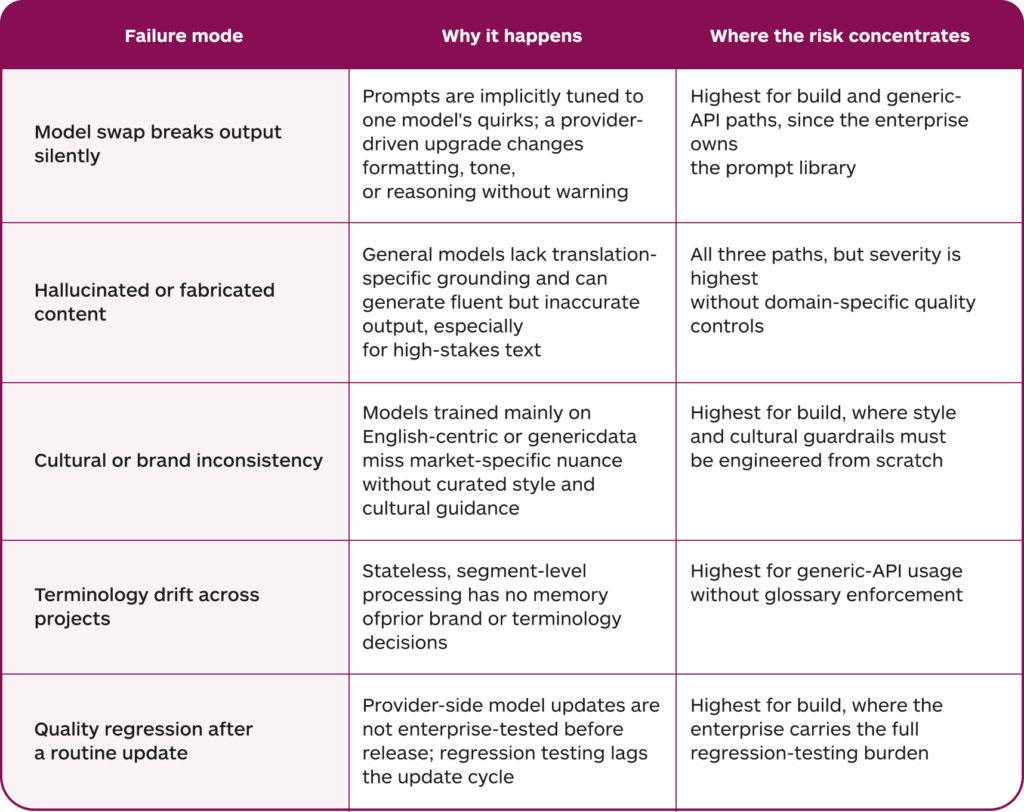
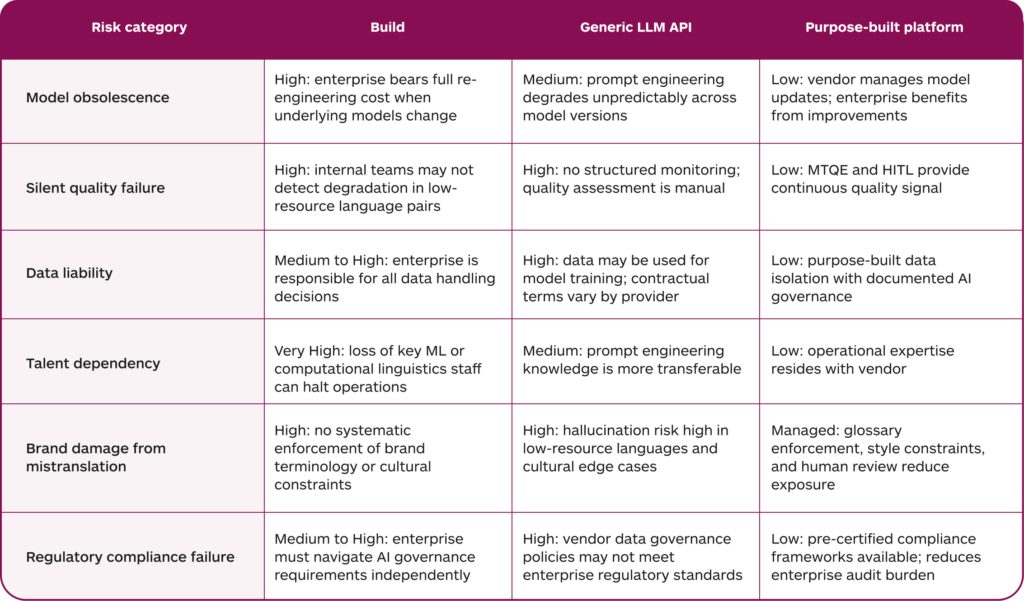
The table below summarizes where production reliability most commonly breaks down, and why the risk is structurally different depending on the path an enterprise chooses.
The Context Ceiling
A key architectural limitation of generic LLMs in translation is what practitioners call the “context ceiling.” Generic models, including GPT-4 and Gemini, operate at the segment level: they translate a sentence with awareness of adjacent sentences, but not of the full document, project-level terminology decisions, brand voice guidelines, or previous translation memory. This produces output that is technically translated but tonally inconsistent, terminologically unpredictable, and prone to hallucination under high-volume conditions.
Production-grade translation requires the model to simultaneously process document-level context, translation memory retrieved through retrieval-augmented generation (RAG), enforced glossary constraints at inference time, style guide parameters, content-type-specific instructions, external reference documents, and real-time human-in-the-loop corrections. Building and maintaining the architecture that delivers all of these context dimensions to an LLM at inference time is the core engineering challenge of enterprise translation AI—and it is not included in any LLM API subscription.
2. The Data and Infrastructure Gap
What Translation Infrastructure Actually Requires
Enterprise data readiness has not caught up with enterprise AI ambition. This is not specific to translation. Gartner projects that, through 2026, organizations will abandon 60 percent of AI projects that are not backed by AI-ready data, and a Gartner survey of data management leaders found that 63 percent of organizations either lack the right data management practices for AI or are unsure whether they have them. Separately, Gartner has estimated that at least 30 percent of generative AI projects are abandoned after proof of concept, citing poor data quality, inadequate risk controls, escalating costs, and unclear business value as the leading causes.
The most common misunderstanding in enterprise AI strategy is treating a capable model as a complete system. The surface-level case for building looks straightforward: An enterprise already has engineers and content, so it appears to already have what it needs. Speakers at SlatorCon London 2026, observed that companies often fall into a “sunk cost fallacy,” assuming that internal engineering resources are effectively free while overlooking maintenance, scalability, governance, privacy, model updates, and future feature requests. The gap between model access and production capability is the data and infrastructure layer that must be built underneath it.
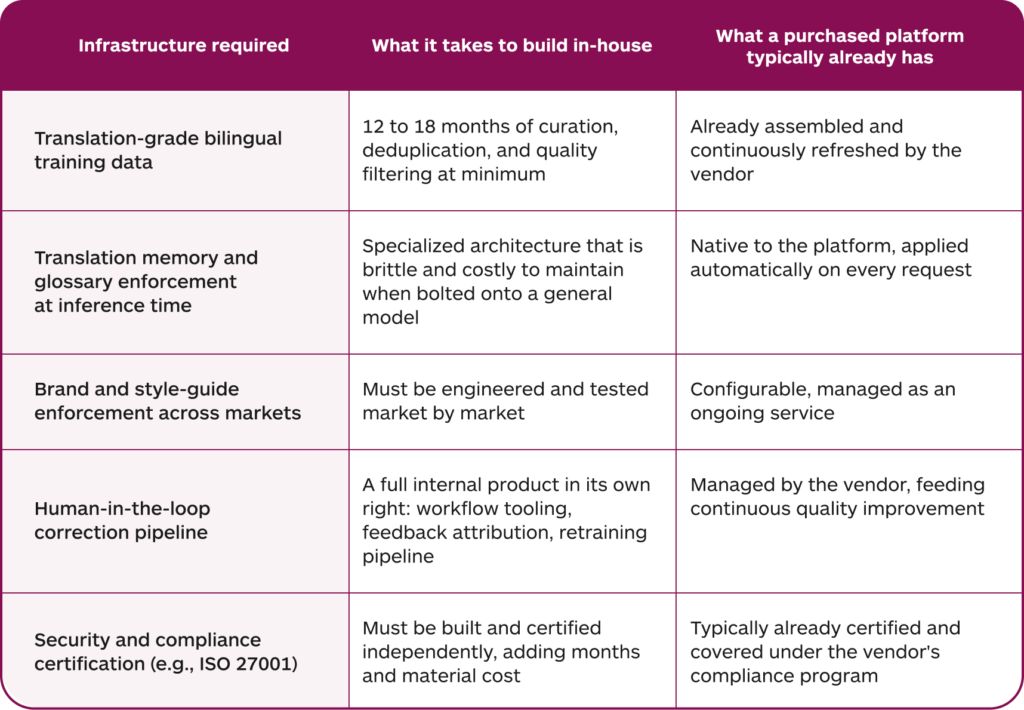
For enterprise translation, this layer includes several interconnected components:
- Translation Memory (TM) infrastructure: A curated, queryable repository of previously approved translations, retrieved semantically at inference time via RAG, not static look-up. Building this requires data engineering, vector database architecture, and ongoing curation.
- Terminology and glossary enforcement: A system that applies brand-specific and domain-specific terminology at the point of generation, not as a post-processing filter. Bolting glossary enforcement onto a generic LLM via prompt engineering is brittle at scale and breaks under volume.
- Human-in-the-loop (HITL) feedback pipelines: The mechanism through which linguist corrections retrain or adjust the system in near real time. This is itself a product—with workflow tooling, linguist interfaces, quality scoring, and feedback loop management—not a feature.
- Format and string constraint handling: Enterprise content includes character limits, UI strings, HTML formatting, markdown, and other structural constraints. Generic LLMs require pre-processing, prompt-engineering workarounds, and post-processing validation pipelines to handle these reliably at scale.
- Security and data isolation architecture: Enterprise content—legal texts, product roadmaps, HR communications, financial disclosures—cannot be processed by public LLM endpoints that may use input data for model training. Building compliant, isolated data flows requires dedicated infrastructure.
KPMG’s analysis of enterprise AI total cost of ownership identifies data harvesting, preparation, ingestion processing, and labeling as costs that accumulate incrementally but become significant financial burdens over time. For translation specifically, data curation is not a one-time expense, but a permanent operational function.
A production translation system needs to draw on several categories of information at the same time, not just the source text. In plain terms, these are: the full document a piece of content sits in, not an isolated sentence, so tone and meaning carry through; the enterprise’s accumulated translation memory and glossary, applied automatically rather than manually; a living style guide that encodes brand voice and formality rules for each market; and a mechanism for capturing linguist corrections in real time so the same mistake is not repeated on the next job. Traditional translation management systems and generic LLM calls were built around a much narrower input, typically just the source sentence and a translation memory match, which is one reason both approaches hit a ceiling on consistency at scale.
Building this infrastructure from scratch is a multi-year undertaking, not a sprint. Industry estimates for curating the volume of high-quality, professionally produced bilingual training data needed for a translation-grade model, as opposed to scraped web text, run 12 to 18 months at minimum, even before the fine-tuning, glossary integration, and human-in-the-loop tooling are built on top of it. Every one of those months is time the core product roadmap does not get engineering attention.
CSA Research’s 2025 post-localization trends research confirms that enterprises are recognizing the limits of generic AI for translation. Their analysis highlights that translation quality in the post-localization era is increasingly treated as risk management: Enterprises must evaluate content based on its potential for legal, brand, and compliance harm—a standard that generalist LLMs without purpose-built quality infrastructure cannot reliably meet.
3. The Human Resource Requirement
The Staffing Reality of a Production AI Translation System
Enterprise technology leaders who have built custom AI systems consistently report a common surprise: Staffing requirements aren’t a one-time build effort. It is a permanent operational function. Experts say: What looks like a bounded engineering project is actually an indefinite commitment to a dedicated team.
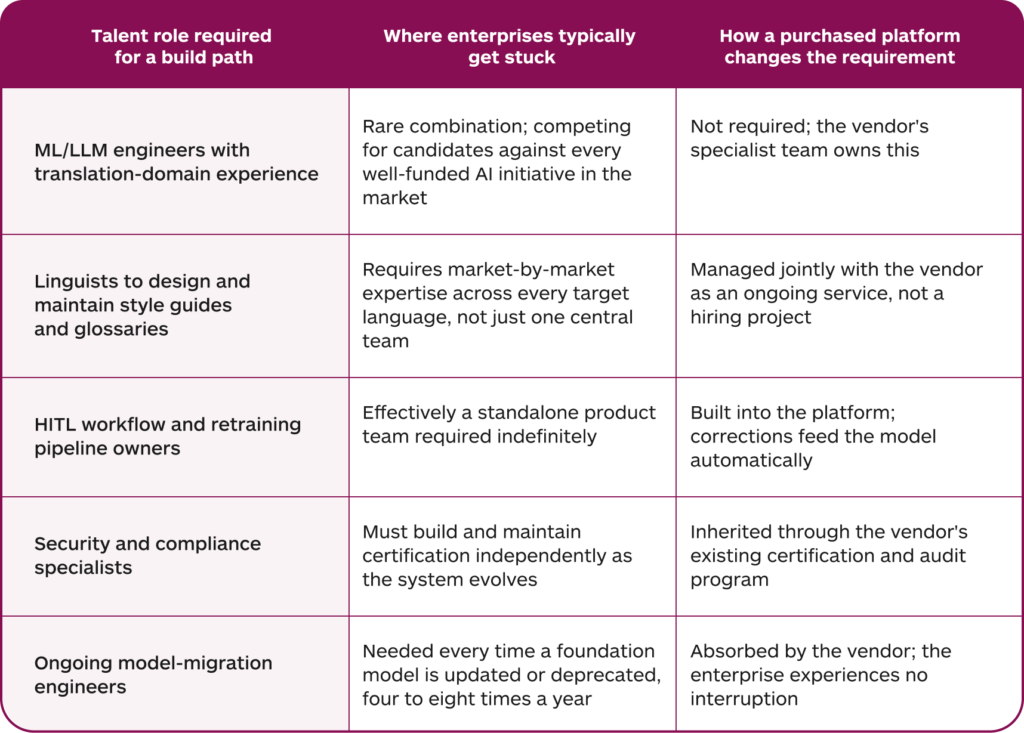
A production LLM translation system requires ongoing staffing across several specialized roles:
- Machine-learning engineers: For model evaluation, fine-tuning cycles, drift monitoring, and infrastructure maintenance as underlying model versions change
- Computational linguists: For quality evaluation, error taxonomy, training data annotation, and language pair-specific debugging that pure engineers cannot perform
- Data engineers: For TM pipeline maintenance, vector database management, data quality monitoring, and the continuous refresh of training and evaluation datasets
- QA linguists: For HITL feedback, error flagging, and the evaluation benchmarks that determine whether the system is degrading or improving
- MLOps engineers: For model deployment, versioning, A/B testing, rollback management, and production monitoring across all language pairs
As the AI landscape evolves, the model underpinning the system will change—whether through vendor updates to foundation models, the emergence of newer architectures, or the organization’s own decision to migrate to a different provider. Each such transition requires the same team to evaluate, re-calibrate, re-test, and re-deploy the system. According to McKinsey’s State of AI 2025 research, only 6% of organizations qualify as high performers achieving more than 5% EBIT impact from AI, and these organizations are investing more than 20% of their digital budgets in AI technologies while focusing on transformative workflows rather than model ownership.
A global shortage, concentrated exactly where translation AI needs it most: Global demand for AI talent now exceeds supply by roughly 3.2 to 1, with an estimated 1.6 million open AI-related positions against about 518,000 qualified candidates worldwide. Within that shortage, natural language processing and large language model specialists face one of the steepest gaps, with demand growing an estimated 198 percent year over year against a much smaller supply pool, and AI roles overall command roughly a 67 percent salary premium over traditional software engineering positions. IDC projects that more than 90 percent of enterprises globally will feel the direct impact of the broader IT and AI skills shortage in 2026, with cumulative economic losses estimated at 5.5 trillion dollars from delayed product timelines and stalled initiatives.
The demand for AI-capable talent extends far beyond localization. PwC’s 2025 AI Jobs Barometer finds that AI-exposed roles are evolving 66% faster than others and command an average 56% wage premium over comparable roles. An enterprise attempting to assemble and retain a specialized AI translation team is competing against the entire AI industry for the same finite pool of engineers—while most of those engineers would prefer to work on product problems that feel strategic rather than infrastructure maintenance on a commodity function. KPMG’s Q1 2026 survey of technology sector leaders found a 92 percent skills gap cited as the top barrier to demonstrating AI return on investment, ahead of every other obstacle measured, with 82 percent citing technical skill gaps specifically as a challenge to deploying AI agents in production.
Translation AI needs a rarer combination than general AI talent: A production translation system is not just a machine-learning problem. It requires the intersection of ML engineering, linguistic domain expertise, and localization operations knowledge, a combination that is scarcer than any one of those skills alone. The people who can fine-tune a model are rarely the people who understand why a formal register in German business correspondence differs from a formal register in Japanese, or why a glossary entry that works for British English breaks down in Australian English. Enterprises that build internally typically end up needing a dedicated ML team indefinitely, not for a single project, because the model landscape and the enterprise’s own content keep changing.
That ongoing cost is a talent cost as much as a technology cost. Human-in-the-loop correction pipelines, in particular, require dedicated linguist workflow tooling and ongoing operational management; industry sources describe building and running that pipeline as effectively standing up a full product team, not a one-time engineering task.
The Opportunity Cost Question
Several speakers at the recent SlatorCon in London suggested that companies should focus on what truly differentiates their business rather than rebuilding technology that already exists and works well. Riccardo Cocco of Tripadvisor used a practical analogy: “You focus on selling the best travel package to your customers. You don’t build the planes.”
Every sprint an enterprise engineering team devotes to translation infrastructure is a sprint not spent on the company’s core product. This is not an abstract trade-off. It is a measurable opportunity cost: Engineering capacity consumed by translation model maintenance cannot simultaneously build the marketplace features, user experience improvements, or platform capabilities that drive core revenue. The organization becomes, as one practitioner described it, “an MT vendor by accident.”
4. Build vs. Buy: A Decision Framework for Executives
The following tables provide the executive-level comparison across the three principal options available to enterprises: building a custom LLM translation system (Build), connecting a generic LLM API to an existing TMS (Bolt-on), and purchasing a purpose-built translation AI platform (Buy).
Table 1: Capability Comparison
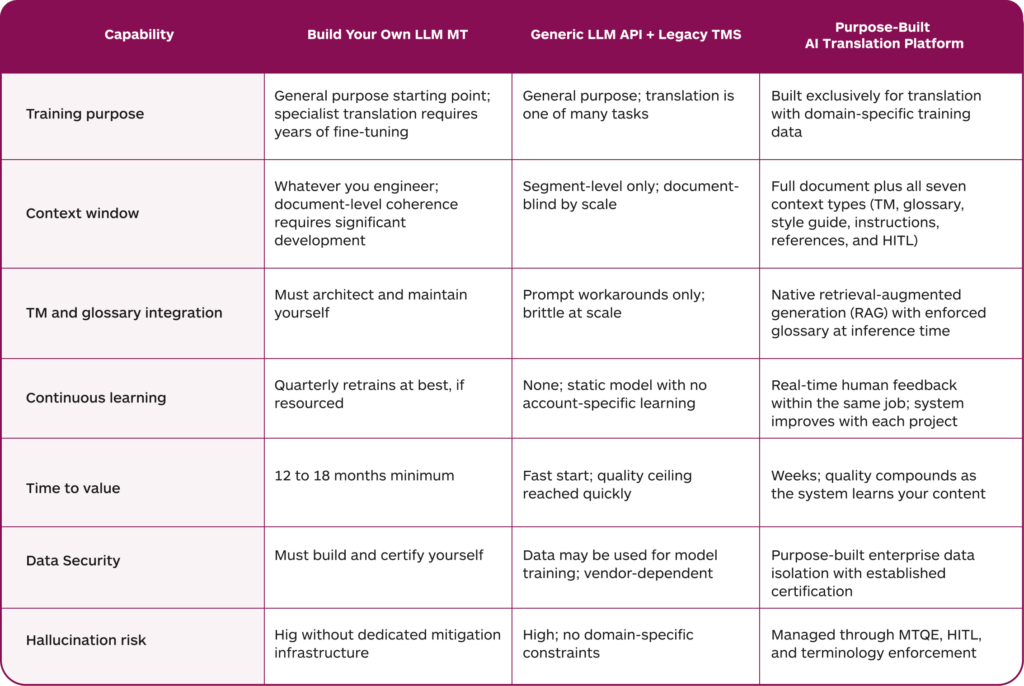
Table 2: Organizational and Operational Requirements
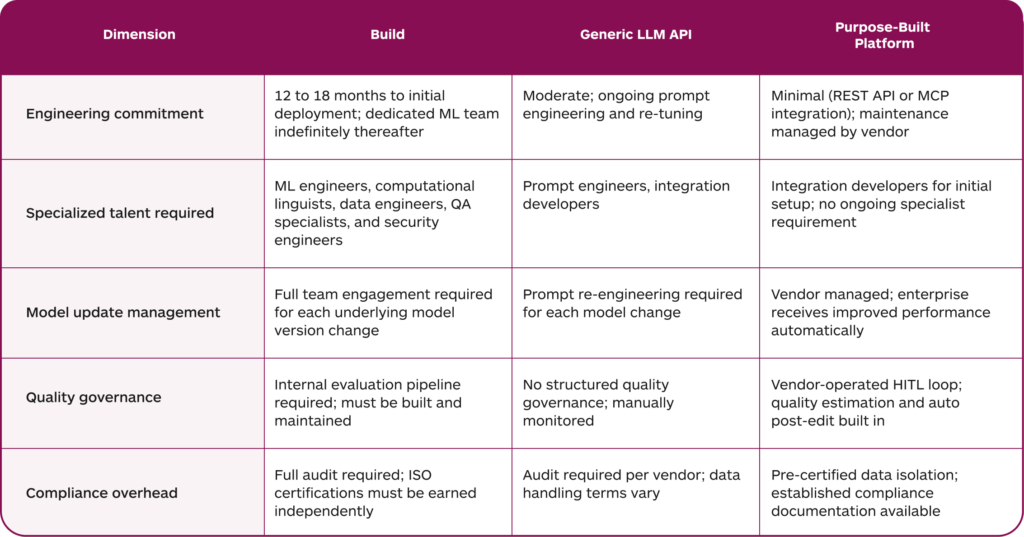
Table 3: Risk Register for Executive Review
A final summary table developed by setting the three paths side by side, across the dimensions that matter most to an executive sponsor and a procurement team rather than an engineering team, makes the trade-offs easier to weigh.
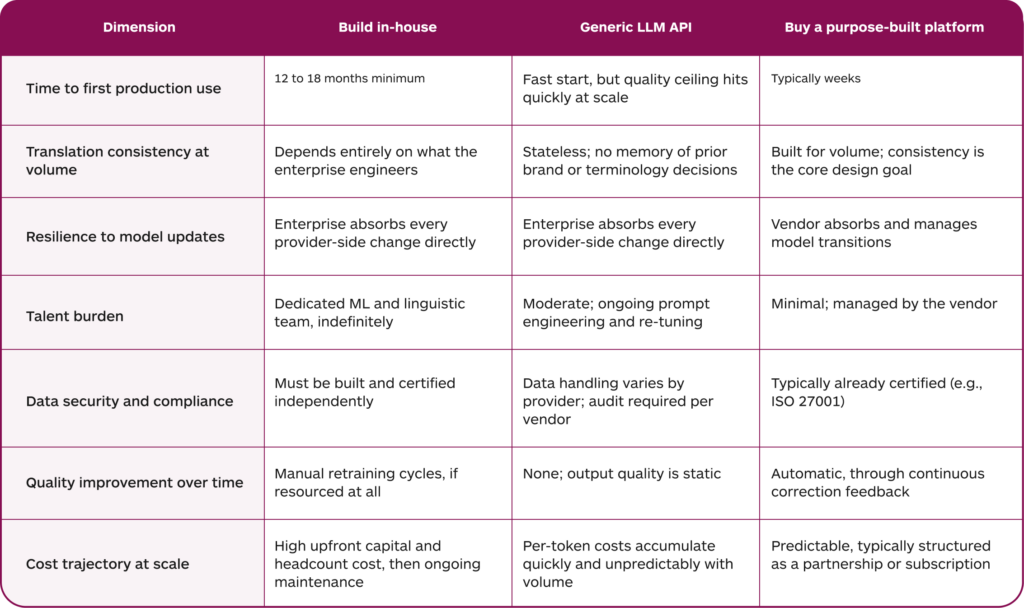
HOW TO READ THESE TABLES
No enterprise should treat this table as a scorecard that always favors one column. A company whose core product is language technology itself, or one with a genuinely unique data asset and the resources to maintain it indefinitely, may have a legitimate case to build. For most enterprises whose core business is not translation, the case for building tends to weaken the further down this table you go.
5. Long-Term Economics and Total Cost of Ownership
The TCO Illusion
The initial build cost for an LLM translation prototype is low: a few days of engineering time and API usage fees. This creates a systematic underestimation of total cost of ownership. KPMG’s analysis of enterprise AI adoption identifies this pattern explicitly: Many organizations have not fully accounted for the true total cost of ownership of AI technologies, and 83% of respondents in KPMG’s 2024 GenAI survey believe investments will increase over the next three years without a clear view of where those costs originate.
Forrester’s research on AI cost scaling found that AI costs are forecast to increase from $2.3 billion in 2023 to $13.8 billion in 2024 industry-wide, with the primary driver being operationalization: the costs of infrastructure, model lifecycle management, governance, and operational overhead that materialize once pilots move toward production. For enterprise translation specifically, the cost structure has three phases that most planning models inadequately capture.
What Initial Estimates Miss
McKinsey’s analysis of more than 5,400 large IT projects found that on average they run 45% over budget and deliver 56% less value than predicted. That is a precise description of the math that governs most enterprise custom AI builds: a project planned to deliver 1 million USD in value at 400,000 USD in cost often becomes a 580,000 USD project delivering 440,000 USD in value—with the ROI flipping negative before the second sprint review.
Gartner research on software cost analysis finds that enterprises miss 50 to 70% of true total cost of ownership in initial calculations, with the most-missed line items being integration, administrative FTE allocation, and migration cost. Forrester estimates that 78% of lifetime software costs accrue after launch, not during initial development—including maintenance, security patching, infrastructure scaling, and the cost of preserving institutional knowledge as staff turns over.
A useful planning rule from enterprise AI cost research: The first year of running a production AI system tends to cost roughly as much as building it did, and the three-year total cost of ownership typically runs two to three times the original build cost, because inference, governance, evaluation, and maintenance are permanent line items, not one-time costs. Separate research places the gap between raw API spend and true operational cost, once monitoring, evaluation, guardrails, and retry logic are included, at 2.3 to 4.1 times the sticker price.
The starkest data point comes from MIT’s NANDA initiative, which tracked enterprise generative AI deployments through 2025 and found that buying or partnering with a specialist vendor succeeded in reaching production value roughly 67 percent of the time, while internal builds succeeded at about one-third that rate. McKinsey’s November 2025 State of AI research reached a compatible conclusion from a different angle: Only 39 percent of organizations report a measurable earnings impact from their AI investments, and nearly two-thirds have not moved beyond the pilot stage. The common thread across both studies is that the barrier is rarely the model itself. It’s the surrounding operational discipline, exactly the layer that a build path asks an enterprise to construct from nothing.
Where the hidden costs accumulate
KPMG’s research on AI total cost of ownership identifies an “adoption tax and risk premium” that typically dwarfs the line-item engineering costs visible in most project proposals after Month 9 of operation. For translation AI specifically, this premium has three components that standard budget models routinely exclude:
Model change overhead. Each time an underlying LLM provider updates their model, an enterprise-built system requires re-evaluation across all language pairs and content types, re-engineering of prompts and constraints, and re-certification of compliance requirements. At current model update cadences, this is not an annual event. It is a recurring operational cost with no natural ceiling.
Linguistic expertise depreciation. Knowledge about why a particular prompting approach works for a given language pair depreciates as models change. The computational linguists and quality specialists who built that knowledge must continuously rebuild it against new model behaviors. This ongoing investment does not appear in Year 1 project estimates.
Opportunity cost of engineering redirection. When enterprise engineering teams spend their capacity on translation infrastructure, they are not spending it on the features and capabilities that differentiate the enterprise in its actual market. For companies where engineering talent is a constrained resource, this opportunity cost is the single largest hidden item in the build decision.
Several cost categories are structurally absent from build proposals presented to executive committees:
Engineering opportunity cost. Every engineer working on translation infrastructure is an engineer not working on revenue-generating product features. This cost is real and compounds every quarter, but it rarely appears in build proposals because it requires assigning a cost to work that was not done.
Knowledge concentration risk. Custom AI systems create dependencies on the individuals who built them. When those individuals leave, the three to six months of reduced productivity while knowledge transfers—estimated at 100,000 USD to 300,000 USD per departure in total cost—is a structural liability in the build path.
Regulatory re-certification. In regulated industries, each model migration may trigger a downstream compliance re-certification cycle. KPMG’s AI governance practice observes that 82% of enterprise leaders identify risk management as their biggest AI challenge, and that many AI governance processes are simply not built to handle the current pace of model change. The localization industry has, in contrast, already developed functional AI governance frameworks from the ground up—green, yellow, and red content tiers for AI, vendor model transparency requirements, per-language quality metrics, and audit logging—ahead of most enterprise AI governance programs.
Silent failure costs. When an internally built AI translation system produces incorrect output, that failure may not be immediately visible. Cocco raised this at SlatorCon 2026: “What happens if an AI localization system fails silently? How quickly would teams notice? Who would be accountable? How would the issue ultimately be fixed?” In production systems handling legal disclaimers, pricing information, or medical content, silent failures carry direct business risk—brand damage, regulatory exposure, and user harm—that dwarfs the cost of any licensing fee.
Ongoing maintenance and management. Across enterprise AI cost research generally, the recurring categories that get underestimated at the proposal stage are consistent:
- Prompt engineering and maintenance, revisited every time a provider updates a model
- Evaluation and quality assurance, including a maintained test set and human review sampling
- Guardrails, content filtering, and PII detection, adding both cost and latency
- Data engineering and pipeline maintenance, consistently the single largest line item in most estimates
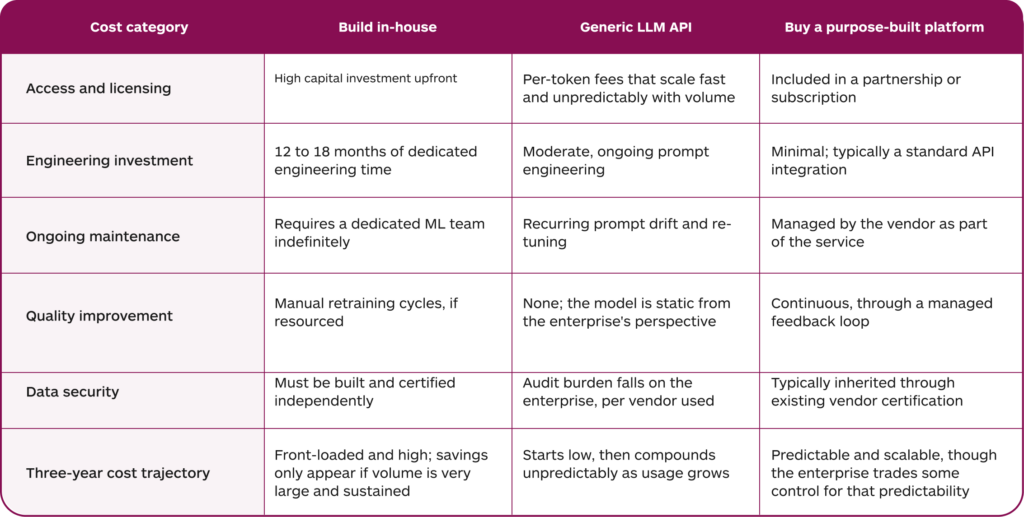
The independent research cited elsewhere in this section on model migration costs, talent shortages, and the MIT and McKinsey production-value findings was not produced by any translation-technology vendor, and it points in a broadly consistent direction. Procurement teams should still require any prospective vendor to substantiate its own TCO claims with reference-checkable customer data before treating them as fact.
The Three-Phase Cost Structure
Phase 1: Build (Years 1 to 2)
The visible costs in this phase include ML engineering time, GPU infrastructure for fine-tuning, data curation and labeling, and TM/glossary architecture development. The costs, frequently invisible, include opportunity cost of engineering capacity diverted from core product, security audit, and compliance certification, and the cost of quality failures during the learning period.
Phase 2: Maintain (Year 2 and ongoing)
This is the phase most enterprise planning models underweight. KPMG’s cost framework identifies model inference costs, monitoring infrastructure, governance and risk compliance, ongoing human-in-the-loop pipeline operations, and model update management as the primary ongoing cost categories. In translation, these costs are compounded by language-pair proliferation: Every new language added to the system multiplies the evaluation, monitoring, and maintenance burden.
The model update challenge deserves specific attention. LLM providers update their models on cycles measured in months, not years. Each update may alter output characteristics—terminology handling, tone, formatting compliance—in ways that require re-evaluation and re-calibration of the production system. Experts state that enterprises should assume anything they build today will eventually become redundant as models evolve. Building for composability—the ability to swap model components without rebuilding the entire orchestration layer—is itself an engineering project that adds to Phase 1 and 2 costs.
Phase 3: Scale (Year 3 and beyond)
At scale, the economics of a custom-built system diverge significantly from those of a purpose-built platform, depending on how learning is accumulated. A generic LLM API connection or custom-built system maintains roughly constant per-unit cost regardless of volume: There is no mechanism for the system to learn from previous translations and become more efficient. A purpose-built platform with embedded HITL feedback and TM integration produces an inverted cost curve: As translation volume grows, the system’s translation memory and language model adaptation reduce the per-unit cost and editing burden, meaning the 100th project costs less than the first.
The Compounding Advantage of Specialized Platforms
The economics of purpose-built translation platforms work in the opposite direction. As the system processes more content from an enterprise, it learns the specific terminology, brand voice, and quality preferences of that organization. The cost per unit of quality translation declines over time. The 100th project is cheaper to process than the first because the system’s accumulated understanding of the enterprise’s content reduces the review burden and error rate.
This inverted-cost curve is a structural property of systems that are designed for continuous learning. It is not achievable in systems where the underlying model is static or where retraining only occurs during scheduled maintenance cycles. Documented enterprise deployments with Lara demonstrate the tangible outcomes this model produces: One enterprise achieved 70% workflow automation and 1.4 million USD in annual cost savings; another expanded into 32 new language markets in three months while recording 40% year-over-year revenue growth.
The pattern emerging from enterprise buyers who have navigated this decision successfully is not pure build or pure buy, but strategic clarification of where internal capability creates genuine competitive advantage versus where it creates infrastructure burden. Enterprises should assume anything they build today will eventually become redundant as models evolve. The solution is not to avoid building entirely, but to avoid building rigid systems.
At Tripadvisor, the architecture decision was to build internal applications that connect to language technology platforms, which then connect to AI models—preserving internal control over user experience and business logic while relying on specialized providers to manage the model layer. This approach allows the company to benefit from every improvement made to the underlying platform without absorbing the engineering cost of those improvements internally.
The practical implication is clear: build at the layer that differentiates your business. Buy the infrastructure layer that specialized vendors have already built, are continuously improving, and have made their entire business to maintain. For global enterprises whose core business is not translation technology, that infrastructure layer is translation itself.
The Right Question for the RFP Stage
Enterprise procurement teams approaching LLM translation decisions frequently frame the evaluation around model capability: Which system produces the best translation output? That framing is incomplete. As the source material establishes, the model isn’t the central variable. The central variables are the orchestration layer, the data infrastructure, and the operational model for continuous improvement.
By the time a formal RFP is issued, research from 6sense found the eventual winner is already on the buyer’s day-one shortlist 95 percent of the time. In the context of translation and localization, this means the vendors and internal teams that will win enterprise trust are the ones that can already demonstrate production reliability before the formal evaluation starts, not the ones promising to build it during the contract.
CSA Research’s Metrix framework, tracking how language service providers evolve, describes a shift from transactional vendors that deliver word counts to strategic partners that deliver measurable business outcomes: international revenue supported, customer experience improvements, and market expansion enabled. The same lens applies directly to the build-versus-buy decision. An enterprise evaluating whether to build or buy its translation AI capability should ask the same question that CSA Research asks of vendors: Will this path let the organization report outcomes, or only report activity?
The formal evaluation criteria enterprise procurement teams already apply to language technology vendors, drawn from industry RFP guidance, translate directly into a build-versus-buy checklist: MT and AI capability with a clear customization approach, quality management and human-in-the-loop process, technology and integration fit, demonstrated scalability, security and compliance certification, and a pricing model tied to outcomes rather than volume alone. An internal build should be held to the same standard a vendor would be held to, not a lower one simply because it originates within the organization.
The right evaluation questions for procurement are:
- Does the system operate at document level, or does it process isolated segments?
- How does the system enforce brand terminology across all language pairs?
- What is the mechanism for incorporating human corrections, and how quickly do they affect output?
- What translation memory architecture is used, and how is semantic retrieval managed at inference time?
- How does the vendor manage model updates, and what is the enterprise’s exposure when underlying models change?
- What data isolation and AI governance certifications are in place?
- What is the total cost trajectory over 36 months, including maintenance and model update cycles?
The CSA Research Perspective on Governance and Risk
CSA Research’s 2025 post-localization trends analysis reframes quality assessment in terms that align directly with the procurement decision: In the post-localization era, translation quality is not about perfection. It’s about risk management. Enterprises need to evaluate content based on its potential harm to customers, brand, and legal standing, and implement governance to manage AI-driven outputs.
This risk-management framing changes the TCO calculation. When translation errors in regulated content carry compliance liability, and when brand terminology inconsistency damages conversion rates in global markets, the cost of quality failure is not just a translation cost. It’s a business risk with consequences that dwarf the apparent savings from a lower-cost build approach.
CSA Research’s 2025 trends analysis frames this as a governance imperative: Enterprises must conduct content audits, understand their content’s risk profile, and implement governance frameworks to manage AI-driven outputs—a standard that informal, prototype-stage internal builds typically cannot meet.
KPMG launched its AI Trust services in 2025 specifically because governance is failing to keep pace with AI deployment speed across the enterprise market. Their framework for trustworthy AI emphasizes that organizations must embed robust safeguards within AI systems and proactively anticipate evolving challenges. For translation specifically, this includes model disclosure, data residency documentation, private inference capability, and output auditability—requirements that enterprise procurement departments are increasingly including in RFPs.
A purpose-built translation platform that operates under documented AI governance, maintains ISO certification, isolates enterprise data from model training, and provides audit-ready output logging substantially reduces the governance burden on the enterprise. A custom-built internal system places the entire governance responsibility—design, implementation, audit, and continuous monitoring—on the enterprise itself.
The Maturity Test for Build Candidates
KPMG’s decision framework for Agentic AI build decisions establishes that internal builds are only appropriate for organizations with advanced technical expertise, robust and scalable infrastructure, well-defined governance, and a clear strategic vision for agent deployment. For translation specifically, the additional prerequisites are:
- Continuous access to computational linguists who understand LLM behavior in each target language required
- An existing curated translation memory and glossary infrastructure to serve as training and context data
- An AI governance and security certification program capable of meeting enterprise data handling requirements independently
- Engineering team capacity sufficient to absorb model updates without displacing core product development
Most global enterprises do not have all of these prerequisites simultaneously. Those that do should still ask whether translation AI infrastructure constitutes a genuine competitive differentiator or a commodity capability that diverts engineering capacity from higher-value work. For the majority, the honest answer is the latter.
A useful starting framework, adapted from enterprise AI strategy practice more broadly, scores a translation AI initiative on two dimensions: whether it creates real competitive differentiation for the business, and whether the enterprise holds genuinely proprietary data that a custom system could exploit better than a purchased one.
- High differentiation and genuinely unique data: A build case may be defensible, but only with a clear-eyed multi-year maintenance commitment, not a one-time project budget.
- High differentiation but largely generic data: A hybrid approach tends to work best, buying the underlying translation-grade model and infrastructure, then building the differentiating workflow and orchestration layer on top of it.
- Low differentiation, regardless of data uniqueness: Buying is almost always the more defensible economic choice; translation is rarely the place a non-language business creates its competitive edge.
This is close to the operating model Tripadvisor described at SlatorCon London 2026: Internal applications connect to a language technology platform, which in turn connects to the underlying AI models, letting the internal team focus on user experience and business logic while the platform vendor absorbs the burden of keeping pace with a fast-moving model layer. Another opinion offered a related principle for any enterprise that does choose to build: favor a composable architecture that can be continuously upgraded over monolithic systems that become difficult to maintain as the AI landscape changes, since virtually anything built today should be expected to require significant rework as models evolve.
Questions worth asking before committing to a build
- What does success actually look like for this system, in business terms, not translation-quality terms, and who is accountable for maintaining it two years from now?
- If the system fails silently, producing plausible but wrong output, how quickly would the organization notice, and through what mechanism?
- Is the required combination of ML engineering and multi-market linguistic expertise already inside the organization, or does it need to be hired into a talent market where demand outstrips supply by roughly three to one?
- Does the organization have a credible plan and budget to absorb four to eight major model updates a year, indefinitely, not just for the first year?
- Has the total cost of ownership been modeled across three years, including data curation, retraining, security certification, and the opportunity cost of engineering time, not just the first year of development?
What Separates a Credible Buy Supplier from a Legacy Platform with an LLM Bolted On?
The buy option is not without its own evaluation requirements. Best practices suggest that companies should think in terms of engaging composable architectures that can be continuously upgraded, rather than investing in monolithic systems that become difficult to maintain. This perspective applies equally to vendor selection. Buying a legacy translation-management system that has attached an LLM API call to its existing segment-centric workflow does not resolve the architectural mismatch described in this article.
A credible enterprise translation AI platform must demonstrate:
- Native context architecture: The ability to deliver full document context—not isolated segments—to the LLM at inference time, along with TM, glossary, style guide, and instructions simultaneously
- RAG-based TM retrieval: Translation memory accessed semantically at inference, not through static fuzzy matching
- Real-time HITL integration: Linguists’ corrections that update system behavior within the same project, not in the next quarterly retrain
- Proven production data infrastructure: Curated, queryable assets across all data types with enterprise-grade security
- Measurable quality outcomes: The ability to connect translation quality to business metrics—conversion rates, support deflection, customer satisfaction—not simply word counts and throughput numbers
Forrester’s 2024 Buyers Journey Survey found that 92% of B2B buyers already have at least one preferred vendor in mind before formal evaluation begins, and 41% enter the process with a single preferred supplier already chosen.
For enterprise translation technology, this means the vendor credibility standard is set during the pre-RFP period—at industry events, in analyst reports from CSA Research, Slator, and Nimdzi, in peer community discussions, and through referenceable production deployments.
Vendors that can demonstrate measurable business outcomes, not just quality benchmark scores, are the ones who earn shortlist positions.
Conclusion: Understand what matters to build predictable, reliable, and consistent production capabilities
The translation AI market has reached a point of structural clarity that should guide every enterprise technology decision. Foundation models from major providers are increasingly commoditized, and open-source alternatives are closing in on proprietary performance while costing far less to run. As a result, competitive advantage in enterprise translation no longer comes from which model a company uses. It comes from the orchestration layer: the data infrastructure, context architecture, feedback loops, security controls, and quality governance that turn raw model capability into dependable production output.
Building that orchestration layer in-house is a multi-year undertaking. It requires a permanent specialist team, continuous capital investment, and the organizational patience to absorb quality problems while the system matures, all while pulling engineering resources away from core product work. For enterprises whose main business is not translation technology, that trade-off is hard to justify when purpose-built platforms already offer the same orchestration capabilities off the shelf.
The Real Decision Isn’t About Model Quality
The build-versus-buy question in enterprise translation AI is not really about which large language model translates best today. Frontier models can already do more than most organizations currently ask of them. The decisive factors are different: Can the enterprise maintain production-grade reliability as models continue to evolve, can it build and sustain the data and orchestration infrastructure needed to make a generically capable model consistently accurate, and can it recruit and retain the rare mix of technical and linguistic talent that this requires, not just once, but on an ongoing basis?
Drawing on Gartner’s research into data readiness, KPMG’s global leadership surveys, MIT’s tracking of production value, and reporting from across the language industry on where AI translation still falls short, the total cost of ownership analysis favors buying purpose-built translation infrastructure for the vast majority of enterprises that are not language technology companies themselves. Those that do choose to build should commit to it as a multi-year effort and hold that internal build to the same reliability standard they would demand of any outside vendor.
The Market Has Already Answered This Question
Menlo Ventures’ 2025 analysis found that 76% of enterprise AI use cases are now purchased rather than built internally, a sharp rise from a 53/47 split the year before. This shift shows that enterprises have largely settled the build-versus-buy debate for common AI applications. Translation is one of the most demanding enterprise AI use cases in terms of domain complexity, data requirements, and reliability standards, making the case for buying proven orchestration capability even stronger here than elsewhere.
Gartner’s finding that only 2% of AI initiatives deliver long-term disruptive value is not a reason to avoid AI investment. It’s a reason to be precise about which AI problems a given enterprise is genuinely positioned to solve better than a specialized provider.
For translation at a global scale, the evidence clearly points to one conclusion: Yhis isn’t one of the AI problems a given enterprise is genuinely positioned to solve better than a specialized provider.